
When using AI in business, the challenge is that results vary depending on the way the person in charge writes instructions and differences in knowledge. "Agent Skills (hereinafter referred to as Claude Skills)" released by Anthropic on October 16, 2025 is a system that aims to achieve both reproducibility of results and work speed by organizing instructions, scripts, and reference materials into one folder and automatically loading them only in situations related to the task. It can be used in the same format from the Claude app, Claude API, and Claude Code, and is effective for specific tasks such as Excel and slide creation.
In this article, we will summarize the main points of the mechanism and functions of Claude Skills, and explain usage examples, fees, introduction steps, and points to keep in mind when operating.
table of contents
Overview of Claude Skills
Claude Skills packages business procedures and company standards as skills, scans available skills during work, and loads the minimum amount of information only when applicable. This balances relevancy and speed, standardizing procedures and ensuring consistency of results, which was difficult to do with prompt sharing alone. Ready-made document-related skills are also provided, so you can immediately try processing Excel, PowerPoint, Word, and PDF.
The skill isAutomatically applied only when necessaryand avoid reading too much information.Works fastI will.
componentis SKILL.md containing YAML metadata and additional files as needed (reference documents, scripts, etc.).
Claude App, Claude Code, APISame format everywhereAvailable at
This design made it difficult to share prompts.Achieving “standardization of business procedures” and “ensuring consistency of results”I will.
Overall picture of the mechanism
Claude Skills has a structure of "folder + SKILL.md + resources and code (as needed)" and is designed to load information in stages. At startup, only the name and description of each skill is kept in a lightweight manner, and when it is determined that it is applicable, the main text and reference files are loaded, and the included code is executed in a safe environment as necessary. This allows long steps to be handled without wasting context.
Composable (automatically combined)
It automatically detects and links multiple skills and supports processing that spans processes, such as a series of tasks from spreadsheet calculations to report creation and slide presentation.
Portable (horizontal expansion in the same format))
The same skill format works across Claude apps, Claude Code, and APIs, so once you create it, it's easy to deploy it laterally.
Efficient (load only when necessary)
"Metadata → Body → Attachment code"progressive disclosureThis allows you to load only what is needed when needed, reducing wasted context.
Powerful (cooperates with code execution)
The code included in the skill can be executed in a safe environment, and decisive processing (e.g. PDF form extraction) that is difficult to do with simple text generation can be performed stably.
These four elements make it practical to standardize and ensure reproducibility, which would be difficult to achieve by simply sharing prompts.
Organize related products and prices
Skills can be used in apps, code environments, and APIs depending on the usage format. Typical plans and usage charges are organized as shown in the table below.
Usage form | Target plan (example) | Main uses | Estimated price |
|---|---|---|---|
Claude (Web/Desktop/Mobile) | Skills available in Pro / Max / Team / Enterprise | Stabilize document, spreadsheet, and presentation generation with skills | Pro$17/month, Max$100/person~,Team$25/person($150/person for Premium seats), Estimate for Enterprise seats |
Claude Code | Available from Pro/Max, included in Team Premium seats | Skill introduction through local development or plug-in type | Compliant with the above plan |
Claude API | Model consumption + tool fee | In Sonnet 4.5 etc.Input $3/MTok/Output $15/MTok. | Pay only for what you use |
The latest amount and upper limit restrictions areOfficial pricing pageBe sure to check the documentation.
Implementation procedures in practice
There are two ways to install it: enable it from the management screen and handle it from the API.
[Introduction in app]
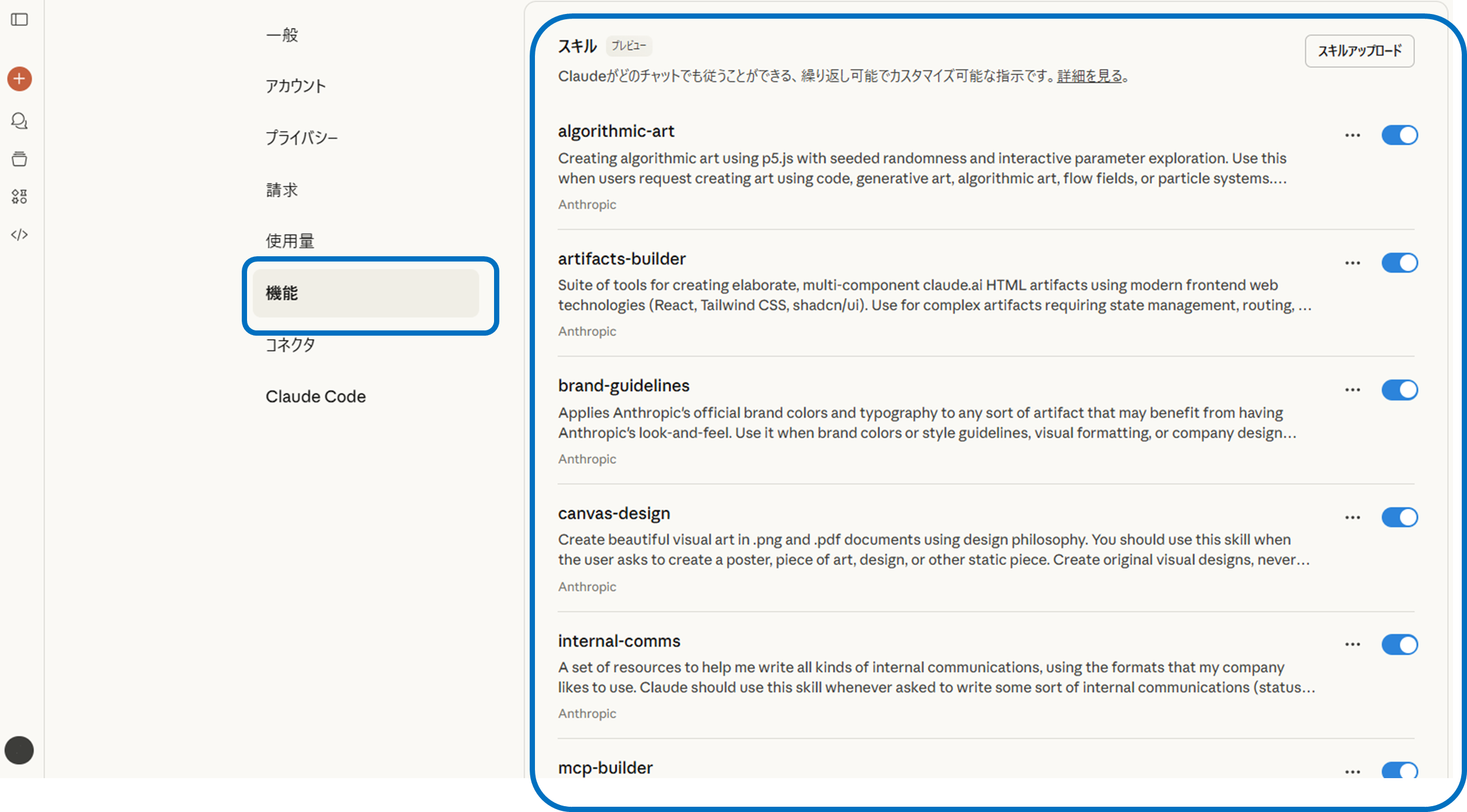
In the Claude app, enable "Skills" on the settings screen, and if necessary, the administrator allows the function for the entire organization.
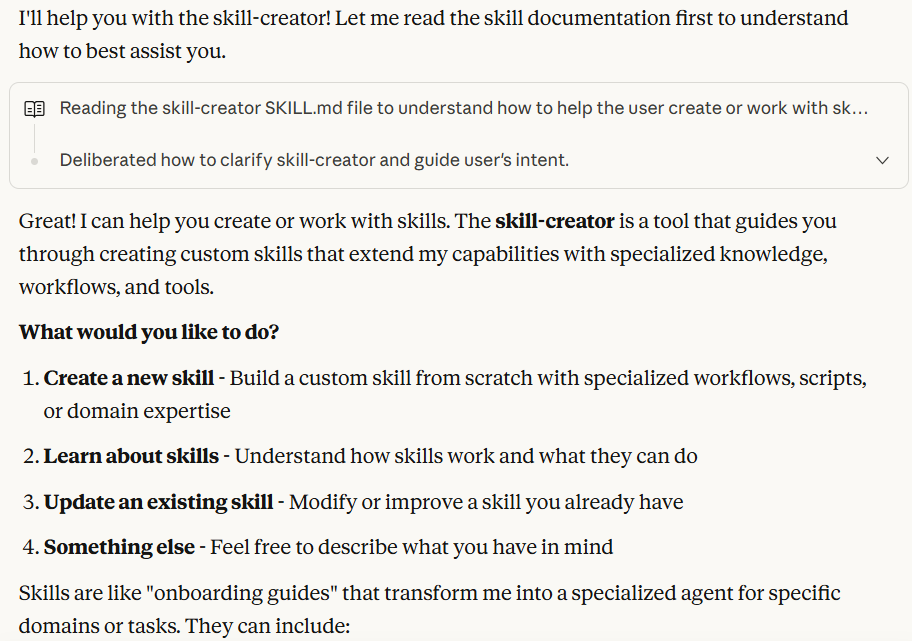
By calling "skill-creator" during dialogue, you can automatically generate SKILL.md, folder structure, and bundled resources while listening to the workflow. Once created, just submit the relevant task and Claude will automatically load the relevant skill.
[Introduction via API]
In the API, attach the skill to the Messages API and call it./v1/skillsof the skill at the endpointVersion control/organization sharingis possible. To executeRequires Code Execution Tool (public beta) and uses beta header addition and possibly the Files API. Pre-built skill IDs such as PowerPoint, Excel, Word, and PDFor upload your own skill for reference.
[Introduced in Claude Code]
If you use Claude Code, please refer to the official GitHubanthropics/skillsofplugin marketplaceand add the desired skill set (e.g.document-skills).
/plugin marketplace add anthropics/skills
locally too~/.claude/skillsIt can be placed in
/plugin install document-skills@anthropic-agent-skills
/plugin install example-skills@anthropic-agent-skills
This way, you can start with no-code and gradually move to tighter control with APIs if needed.
Specific image of usage scene
Here, we will summarize the specific uses of the tool based on comments from partners published in the official announcement.
Box: Automatically generate PowerPoint/Excel/Word files that meet organizational standards based on stored files, reducing work time.
Notion: Reduces the burden of adjusting prompts even in complex tasks and increases predictability of results.
Canva: Customize agents and deeply integrate them into design-based workflows.
Rakuten: Streamline the processing of multiple spreadsheets, detect anomalies, and generate reports according to procedures.
These examples are suitable for applications where you want to increase the reproducibility of routine tasks, such as document generation or data processing.
Checkpoints for operational design
In order to achieve both stable operation and governance, we first incorporate the following perspectives into the design.
Hire only reliable skills
Preliminary audit of sources, dependencies, bundled scripts, etc. Also check whether there is an external network connection and the data transfer destination.
Least privilege and execution boundaries
Although code execution is a sandbox, it clarifies permission design, network boundaries, and handling of secret information.
Version control/distribution
/v1/skillsRelease management and organizational distribution. The naming and description are strictly related to Claude's automatic selection accuracy.Evaluation and regression testing
Regularly evaluate performance, consistency, and cost on representative tasks and reflect improvements in SKILL.md.
cost design
Estimate the plan usage limit, model usage, and additional costs for web search/code execution.
By implementing a phased introduction (limiting trials to specific operations → evaluation → horizontal deployment), quality can be solidified while limiting the scope of impact.
Points to note and risks
In exchange for strength, it is essential to have appropriate safety measures and operational rules in place.
The risk of malicious skills or dependencies is that they may contain suspicious code, images, or external connections.Thorough auditing and reliable sources are required before implementation.is. In addition, the code execution function is currently in the public beta stage, and when using the API, it is required to specify a beta header and use it in conjunction with the Files API, and it is also important to note that it is susceptible to specification changes.
Regarding data handling,It is important to clearly establish internal rules regarding how to capture confidential information, log policies, retention period, etc.is. Furthermore, to prevent misapplication, it is essential to improve the accuracy of skill names and descriptions.Continuous tuning based on task observationsis required.
The basics of operation are three pillars: ``Use only reliable skills,'' ``Operate with minimal authority,'' and ``Perform regular evaluation.''
summary
Claude Skills is a system that simultaneously improves the consistency of deliverables and processing speed by packaging business procedures and internal standards as skills and automatically loading them only when needed. The same format can be shared between Apps, APIs, and Claude Code, and you can immediately try out pre-built skills for documentation. A realistic way to implement this is to enable Skills in Apps, create the first skill with "skill-creator", and once you see the effect, expand to distribution and version management using API /v1/skills. You can get an idea of the price by looking at the three axes: subscription, API usage, and server-side tools.
As your next action, try converting just one existing Excel or presentation creation procedure into a skill and evaluate the reproducibility and cost using actual data.